Succession planning for every role, not just C-suite positions, has become essential. The pandemic forced organizations to think about contingency and rapid redeployment across the entire workforce—not just critical talent. A strategic workforce manager at Allied Irish Bank reframed the challenge: when a branch closes or a team member vanishes due to illness, you need visibility into capability across all roles to redeploy at speed.
The Hiring Excellence Podcast · Episode 18
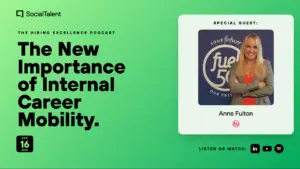
The New Importance of Internal Career Mobility with Anne Fulton
Why internal mobility has become critical post-pandemic—and how transparent talent marketplaces unlock retention, reskilling, and rapid redeployment at scale. Anne Fulton shares frameworks from Abbott Labs, Schneider Electric, and Allied Irish Bank.
 Johnny CampbellHost · Co-founder & CEO, SocialTalent
What you'll learn
Question AI hiring tools trained only on your past hiring patterns
Plan succession and rapid redeployment for every role, not just leadership
Track project contributions and skills instead of fixed job titles
Give employees control over what career interests stay visible internally
00:00
--:--
Episode notes
Episode key takeaways
Transparency drives engagement and retention far more than gatekeeping ever will. When leaders can see their own talent pipeline and employees control what career aspirations they share, fear of losing talent dissolves. Organizations using internal talent marketplaces report 15% churn versus 24% without them—a 60% reduction across multiple clients.
Anne Fulton emphasizes that work is being deconstructed: career growth is no longer vertical movement or a job title, but lateral moves, project contributions, and skill development. One large Australian bank found expertise was the number-one career driver across 18,000 employees—not promotion. This shift requires tracking contributions, not just positions.
Algorithms must be built on robust organizational data and diversity principles from the start. The risk of perpetuating bias is highest when AI systems are trained on historical hiring patterns without correction. Building D&I imperatives into the skills architecture itself—not bolted on later—ensures fairness and mitigates legal and cultural risk.
A talent marketplace succeeds only when underpinned by a clear talent philosophy and charter. The tool is secondary; the belief system comes first. Education, transparency principles, and leadership alignment transform the marketplace from a software project into cultural change that drives productivity, retention, and business outcomes.
Good to know
Frequently asked questions
The quick answers behind this episode.
How do internal talent marketplaces reduce employee churn? +
By surfacing career challenges and retention risks early, leaders can intervene with coaching questions before disengagement sets in. When employees see transparent pathways for growth—stretch assignments, lateral moves, skill development—they’re more likely to stay. Organizations using internal marketplaces report 60% lower churn than those without them.
What happens if multiple team members apply for internal roles simultaneously? +
Employees aren’t flagged as ‘on the move’ to their manager until a hire is secure. They express interest in target roles, projects, or stretch assignments visible to HR and recruiters, not their direct manager. This preserves privacy while giving leaders visibility into team interests and future capability needs.
Can AI predict when employees will leave? +
Yes, retention predictors based on career stage, tenure, career satisfaction, and desire for challenge can signal risk 6–9 months in advance. Rather than using this to control talent, leaders should use it as a coaching prompt: ‘I noticed you’re looking for more challenge—how can I help?’ This shifts retention outcomes significantly.
How do you build a skills architecture that supports diversity and inclusion? +
Embed D&I principles into the architecture from day one, not as an afterthought. Include trending capabilities like diversity awareness and cultural competence. Use AI to match skills anonymously (without names or photos) to reduce bias. Audit the data underpinning algorithms to ensure they don’t perpetuate historical hiring patterns.
What's the difference between internal mobility and succession planning? +
Succession planning traditionally focused on replacing C-level and critical roles. Internal mobility is continuous, organization-wide, and driven by employee choice and business need. It includes rapid redeployment, lateral moves, project-based work, and skill-building—not just preparing replacements for senior positions.