Personalization at scale cuts content creation time by 75% when AI systems are properly trained on persona data. One electronics company automated seven different candidate newsletters by feeding their AI chatbot detailed persona profiles, then feeding it a single base content piece—but human review remains non-negotiable because even best-in-class systems still hallucinate.
The Hiring Excellence Podcast · Episode 166
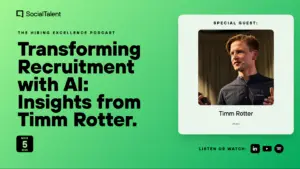
Transforming Recruitment with AI: Insights from Timm Rotter
Timm Rotter explores how AI transforms employer branding, onboarding, and candidate assessment—while exposing critical risks around bias, hallucinations, and data privacy that recruiters must navigate.
 Johnny CampbellHost · Co-founder & CEO, SocialTalent
What you'll learn
Automate persona-based content creation to cut writing time by seventy five percent
Deploy AI avatar video to localize onboarding training across many languages
Recognize that candidates may use real-time AI prompts invisible to interviewers
Avoid deploying AI screening tools that replicate historical hiring bias
00:00
--:--
Episode notes
Episode key takeaways
AI avatars powered by tools like HeyGen now deliver onboarding videos in 17 languages without reshooting. An insurance client uses this to update compliance training instantly; a Munich pharma company's head of video created a deepfake so convincing that employees called to verify whether the CEO had actually granted a free day.
Timm argues that candidates using AI interview tools—real-time prompts, resume generators, application bots—are not cheating; they're signalling future-readiness. The burden shifts to recruiters: deeper domain expertise, better probing questions, and the ability to distinguish authentic knowledge from scripted responses.
Bias in AI hiring tools mirrors historical hiring bias baked into training data. Amazon's recruiting algorithm preferred male candidates for technical roles because the company had historically hired men; a Munich news outlet exposed a video-screening tool that scored the same candidate differently based on whether they wore a headscarf.
Three risks dominate: hallucinations and deepfakes, algorithmic bias, and inadequate staff training. Data security is the immediate threat—any unvetted tool storing prompts on US or Chinese servers violates GDPR. Mandatory AI literacy across the organization is the single biggest lever to mitigate exposure.
Good to know
Frequently asked questions
The quick answers behind this episode.
How can recruiters detect when candidates are using AI interview tools? +
Real expertise in a domain is hard to fake convincingly with AI. If a candidate can fluently discuss semiconductor production or pivot authentically to personal anecdotes, they likely know the subject. Recruiters must deepen their own domain knowledge, ask probing follow-ups, and test for contextual consistency. In-person interviews become more valuable than written assessments or virtual interviews alone.
What's the biggest risk of using ChatGPT or similar tools in recruiting? +
Data privacy. Any unvetted prompt entered into the public ChatGPT interface is stored on US servers; DeepSeek stores data on Chinese servers. Both violate GDPR immediately. Organizations must mandate approved tools, train staff on data handling, and enforce policies—otherwise employees bring their own devices and expose sensitive candidate or company information.
Can AI reduce bias in hiring? +
No. AI tools inherit the biases present in their training data. If historical hiring favoured men in technical roles, the algorithm will too. Amazon’s recruiting model failed for this reason. Bias is invisible because the tool produces the same output humans learned to expect. Auditing training data, testing for disparate impact, and maintaining human oversight are essential.
How should companies approach AI adoption in recruiting? +
Start with mandatory AI literacy training across the organization. Establish approved tools—aim for mastery of 10 rather than surface familiarity with 200. Train recruiters on assessment skills and domain expertise. Use AI to automate low-value work (content variation, video localization) but keep humans in the loop for quality assurance, bias detection, and final hiring decisions.
Is AI adoption a talent differentiator for employers? +
Yes, currently. Candidates—especially high performers—are attracted to organizations visibly investing in AI and encouraging responsible experimentation. Conversely, companies that ban AI tools risk losing talent to competitors perceived as more future-ready. As AI adoption becomes universal, this advantage will fade, but early movers gain a window to attract innovation-minded talent.