CVs have never reliably predicted job fit in high-volume hiring. For entry-level food and beverage roles, recruiters were scanning for one signal: prior work experience in a similar environment. Everything else on the page was noise. Replacing that with five open-ended behavioural questions delivered via AI chat takes 20 minutes, surfaces personality and values alignment, and generates a 0–100 fit score plus tailored interview questions—all without sacrificing human review.
The Hiring Excellence Podcast · Episode 162
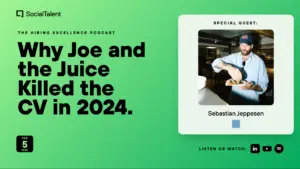
Why Joe and the Juice Killed the CV in 2024 with Sebastian Jeppesen
Joe & the Juice scrapped CVs entirely in 2024, replacing them with AI-powered behavioural interviews. Sebastian Jeppesen shares how they cut time-to-hire by 33% while boosting candidate NPS to 9/10—and why human judgment remains non-negotiable.
 Johnny CampbellHost · Co-founder & CEO, SocialTalent
What you'll learn
Replace CV screening with a scored AI chat interview for high-volume roles
Keep a human recruiter making the final call even after automating screening
Cut time-to-hire by a third by moving straight to a chat interview
Give every candidate personalized coaching feedback regardless of interview outcome
00:00
--:--
Episode notes
Episode key takeaways
Time-to-hire dropped 33 percent, from 18 days to 12 days, after implementation. That efficiency gain matters less than the candidate experience shift: 91% of applicants report feeling more self-aware after the process, and 60% voluntarily leave positive reviews. For a consumer brand where applicants often overlap with customers, a bad recruitment experience is a revenue leak. A best-in-class one is brand reinforcement.
Sebastian emphasizes that full automation from application to offer letter contradicts the company's people-centric mission. Recruiters and regional managers retain final hiring authority, armed with AI insights into their own bias and recommended questions targeting candidate gaps. The philosophy is clear: AI makes decisions fairer and less biased, but people hire people.
Vendor selection and change management were underestimated. Choosing a partner requires alignment on values, not just feature parity. Rolling out across 17 markets in nine months in phases—starting with lower-volume regions—reduced risk. But the biggest lesson was one-on-one stakeholder engagement before launch. Recruiters needed to understand why the process was changing, not just be told it was better.
Retention-driven hiring is the next frontier. Feedback loops between hiring outcomes and tenure data will let the system learn which personality profiles and competency weightings predict long tenure and promotion into management. This shifts assessment from generic 'juice DNA' to market-specific and role-specific predictors, turning recruitment into a retention lever.
Good to know
Frequently asked questions
The quick answers behind this episode.
Why did Joe & the Juice remove CVs from their hiring process? +
CVs added little value for entry-level hiring and created bias and unfair processes. The company feared 95% of applicants received poor experience despite investing time in applications. A bad recruitment experience risked damaging brand perception among customers who overlap with the applicant pool. Replacing CVs with behavioural chat interviews improved fairness, speed, and candidate satisfaction.
How long does the new Joe & the Juice application process take? +
The full process averages 20 minutes. Candidates provide basic info (name, phone, email), answer knockout questions (right to work, age), then complete five open-ended behavioural questions via AI chat. Some finish in five minutes; others take 40. Overall, it’s faster than tailoring a cover letter to each employer and yields deeper insight into candidate values and fit.
What data do recruiters see after a candidate completes the AI interview? +
Recruiters receive a 0–100 fit score, a talent insights profile showing personality strengths and challenges, and recommended interview questions tailored to gaps. This replaces manual CV screening. The system also provides coaching tips to all candidates, regardless of hire outcome, boosting candidate NPS to 9/10 and self-awareness scores to 91%.
Did Joe & the Juice fully automate hiring decisions with AI? +
No. Recruiters and regional managers retain final hiring authority. AI surfaces insights and reduces bias, but humans make the decision. This aligns with the company’s people-centric mission: ‘People hire people. We just leverage AI to make that decision more fair and less biased.’ Full automation from application to offer letter was never considered.
What was the biggest lesson from rolling out AI hiring at scale? +
Change management was underestimated. Assuming recruiters would embrace the system without engagement backfired. One-on-one conversations, explaining the ‘why’ before rollout, and phased implementation across lower-volume regions first reduced resistance. Vendor selection also matters: choose a partner aligned on values, not just features, because it’s a long-term partnership.