
By Lee Flanagan
✨ AI Summary:
- Prioritize interview intelligence platforms that evaluate and coach interviewers, not candidates, to drive consistent, high-quality hiring decisions.
- Choose tools that connect interview insights directly to targeted training to close the loop on interviewer capability and improve behaviour over time.
- Mitigate compliance risk by using platforms that omit biasing interview content from summaries and surface it privately for coaching instead of creating discoverable records.
- Match your platform choice to your biggest hiring challenge: volume (automation), quality (documentation), or capability (training and coaching) for best long-term impact.
Last updated: April 2026
A buyer’s guide for enterprise TA leaders evaluating interview intelligence in 2026. We compare 12 platforms across methodology, compliance posture, enterprise readiness, and the capability that matters most this year: whether the tool actually makes your interviewers better, or just records them talking.
The Short Answer: What is an Interview Intelligence Platform?
An interview intelligence platform is software that captures, structures, and analyses hiring interviews so talent teams can run them consistently, review them objectively, and improve them over time. Most platforms sit inside video conferencing tools, transcribe the conversation, align notes to a scorecard, and surface patterns post-interview. The better ones go further: they guide interviewers in the moment, evaluate interviewer behaviour (not the candidate), and feed insight back into training. SocialTalent’s Cara is built around that definition — she plans the interview, guides the interviewer live, and turns what she sees into a coaching moment tied to a specific lesson.
The category matters more in 2026 than it did even a year ago. Every candidate now shows up AI-assisted. Rehearsed, polished answers are the floor. The interview itself, the 45 minutes where a human is supposed to validate depth, probe for evidence, and make a defensible decision, has become the single most fragile moment in hiring. Interview intelligence is how enterprise TA teams protect it.
The 12 Platforms, At a Glance
Here are the 12 interview intelligence platforms we’d put in front of an enterprise TA leader evaluating the category in 2026:
| Platform | Evaluates | Best For | Key Differentiator |
|---|---|---|---|
| SocialTalent (Cara) | Interviewer | Enterprise TA (10,000+) | Coaches the interviewer and connects feedback to training |
| BrightHire | Interviewer | Mid-market & enterprise | Recording and scorecard coaching visibility; no connected training |
| Metaview | Conversation (notes) | Recruiting note-taking | AI scribe with clean ATS sync |
| Pillar | Interviewer | Employ-stack teams | Real-time in-interview guidance to reduce bias |
| HireVue | Candidate | Global high-volume video | Structured video interviewing and assessments at scale |
| Sapia.ai | Candidate | Consumer and retail volume | Identical chat-based async first interview for every candidate |
| Paradox (Olivia) | Candidate | Frontline and hourly at scale | Conversational screening, scheduling, and candidate flow |
| Humanly | Candidate | Mid-market TA | Conversational screening plus interview intelligence in one |
| Phenom | Candidate | Large-enterprise TXM buyers | Interview automation inside a talent experience platform |
| Eightfold AI | Candidate | Talent-intelligence buyers | AI Interviewer inside a skills-graph ecosystem |
| Harver | Candidate | Assessment-led hiring | Pre-employment assessments and culture-fit analysis |
| Hireflix | Candidate | Growing companies | Simple one-way async video with flat pricing |
Shortlisting two or three of these? Our side-by-side comparisons go deeper on price and fit: Metaview alternatives, BrightHire alternatives, Metaview vs BrightHire, HireVue alternatives and SocialTalent vs HireVue.
How We Evaluated Each Platform
Every “top vendors” list on the internet uses different criteria, and most of them hide the criteria entirely. Here’s what we used, and why:
- Methodology depth – Does the platform embed a defined hiring methodology, or does it leave interviewers to invent their own?
- Full-loop coverage – Does it support the before (plan), during (guide), and after (coach) stages, or only one?
- Evaluation target – Does it evaluate the candidate, the interviewer, or both? This is the single most important distinction in 2026.
- Compliance posture – How does it handle interview data, discoverability, and bias?
- Enterprise readiness – ATS integrations, SOC 2, admin controls, adoption track record at 10,000+ employee organisations.
- Training linkage – Does feedback connect to actual learning, or does it stop at “here’s what went wrong”?
One note on bias. We make SocialTalent. We still tried to write this fairly. You will form your own opinion on whether we succeeded.
1. SocialTalent (Cara): AI hire for the full interview loop.
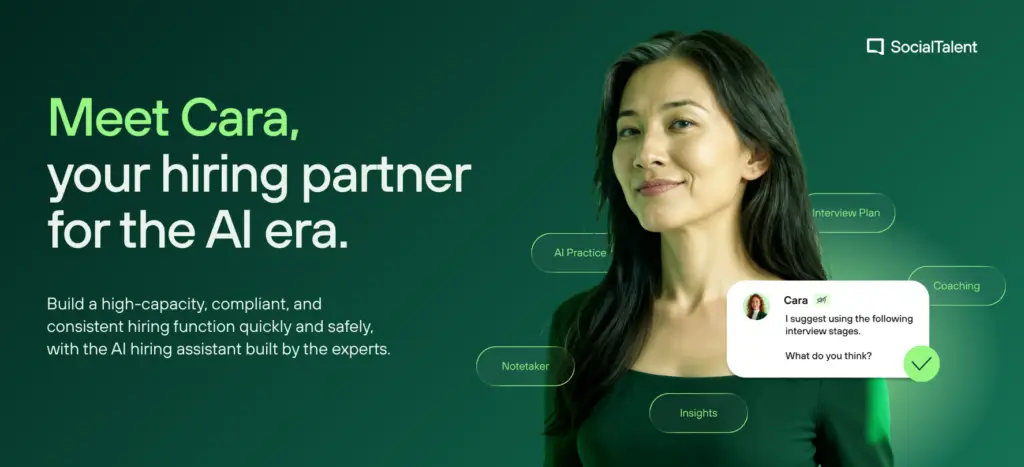
Best for: Enterprise TA teams (10,000+ employees) who want interview intelligence tied to a defined hiring methodology, with training, execution, and coaching in one closed loop.
Cara is SocialTalent’s AI hire. She plans the interview, guides the interviewer and coaches them afterwards, all grounded in the hiring methodology SocialTalent has refined across 15 years of training hiring managers at enterprise scale. Interview Intelligence is a capability Cara delivers now, not a separate product to stitch together.
What separates Cara from the other eleven platforms on this list is a design choice most categories won’t state plainly: Cara evaluates interviewers, not candidates. After the conversation, Cara analyses interviewer behaviour across multiple dimensions (probing quality, criteria coverage, talk-time ratios, risky or biased questions, structure adherence) and sends feedback privately to the interviewer. It does not judge the person in the seat. It helps the person running the interview get better at the job.
The closed loop is the structural differentiator. Most tools stop at “here’s what happened in the interview.” Cara identifies the specific gap, maps it to a two-minute micro-lesson from the SocialTalent learning library, and delivers it before the next interview. Insight intervenes, not just informs.
Key features:
- AI Interview Planner: job description to structured, multi-round interview plan with scoring rubrics in under five minutes
- AI Interview Assistant: plan, questions, criteria, and rubrics surfaced inside Microsoft Teams, Zoom, or a standalone window during the interview
- AI Interviewer Analytics: private coaching feedback mapped to specific transcript evidence, with targeted training recommendations
- Interviewer certification paths (Licensed To Hire, Advanced, Licensed Interviewer) connected to in-the-moment gaps
- Biasing content omitted rather than summarised, with a compliance signal surfaced to leaders
- ATS sync with Avature, Greenhouse, Workday, SAP SuccessFactors, and more
Stand-out strengths: Defined hiring methodology, training and execution in a single loop, interviewer-first design, explicit bias handling rather than bias laundering.
Limitations to consider: Built for enterprise. If you’re hiring 30 people a year and don’t have a TA enablement function, this is more capability than you’ll activate.
2. BrightHire: Interview Recording and Intelligence
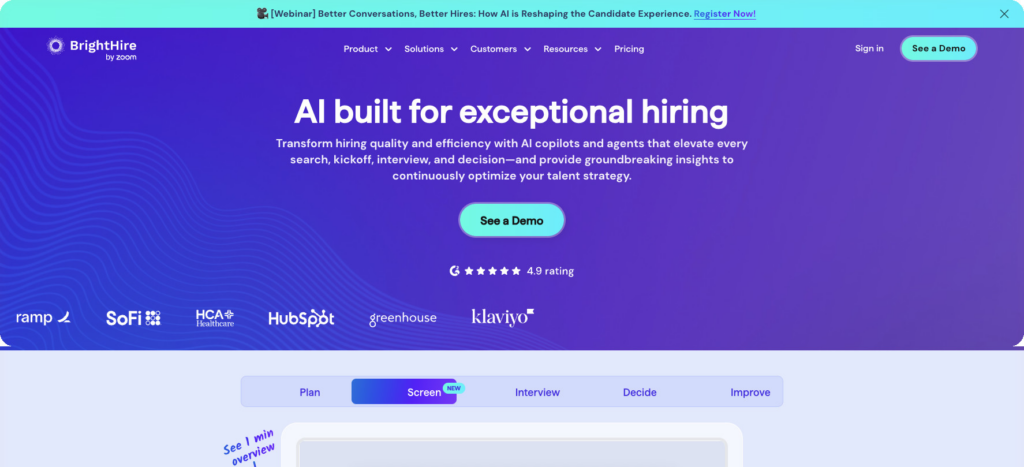
Best for: Mid-market and enterprise organisations that want interview recordings, transcription, and scorecard-driven coaching visibility.
BrightHire is one of the longest-running names in the category. The product records interviews conducted inside Zoom, Google Meet, or Microsoft Teams, transcribes the conversation, aligns highlights to a scorecard, and gives hiring leaders visibility into who is interviewing well and who needs coaching. Integrations with Greenhouse, Workday, and Lever are mature.
BrightHire’s positioning has sharpened around compliance and interview quality oversight. The platform analyses interviewer behaviour at the pattern level (talk ratios, question types, structure adherence) and surfaces the signal to recruiting leaders. The coaching happens by making interview quality visible.
Key features:
- Interview recording and transcription inside major video tools
- Scorecard automation and highlight reels for debriefs
- ATS sync with Greenhouse, Workday, Lever
- Interviewer analytics and coaching dashboards
Stand-out strengths: Mature product, deep ATS integrations, strong compliance orientation.
Limitations to consider: Core evaluation lens is candidate-centric. Coaching is surfaced to leaders, which some interviewers experience as oversight rather than enablement. No integrated training library to close the loop on skill gaps once they’re identified.
Considering BrightHire? See our BrightHire alternatives and Metaview vs BrightHire comparisons.
3. Metaview: The AI Scribe for Recruiting
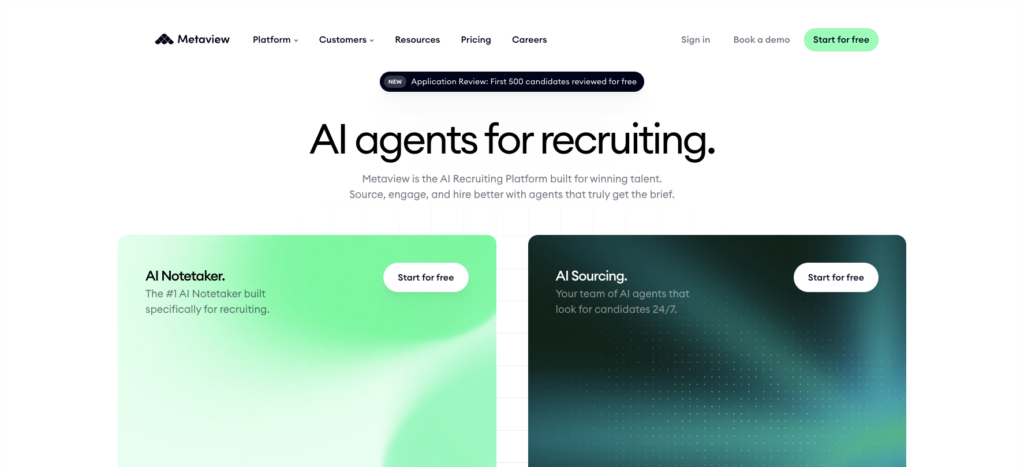
Best for: Recruiting teams that want to stop typing during intake calls and interviews, and pipe structured notes straight into the ATS.
Metaview is purpose-built to replace the recruiter’s notepad. The tool joins interviews and intake calls, transcribes them, and produces structured notes aligned to a template, then pushes them into the ATS scorecard. It’s widely used by growth-stage companies: Brex, Deel, HelloFresh, and Quora are among the roughly 2,000 customers on its website. The company raised a $35M Series B in June 2025 led by GV.
Metaview sits closer to “AI note-taker for recruiters” than “interview intelligence platform” in the strict sense, and that’s the point. For teams whose main pain is the hour recruiters lose every day to manual notes, Metaview solves it.
Key features:
- AI-generated interview and intake call notes
- Configurable note templates
- ATS scorecard autofill
- Recruiter-focused workflows
Stand-out strengths: Simple, focused, quick to deploy. Recruiters love it.
Limitations to consider: The product is a scribe, not an interviewer evaluation engine. It automates documentation rather than intervening in the quality of what’s being documented.
Considering Metaview? See our Metaview alternatives comparison, including its current pricing.
4. Pillar (Employ’s AI Interview Companion): Real-Time Guidance
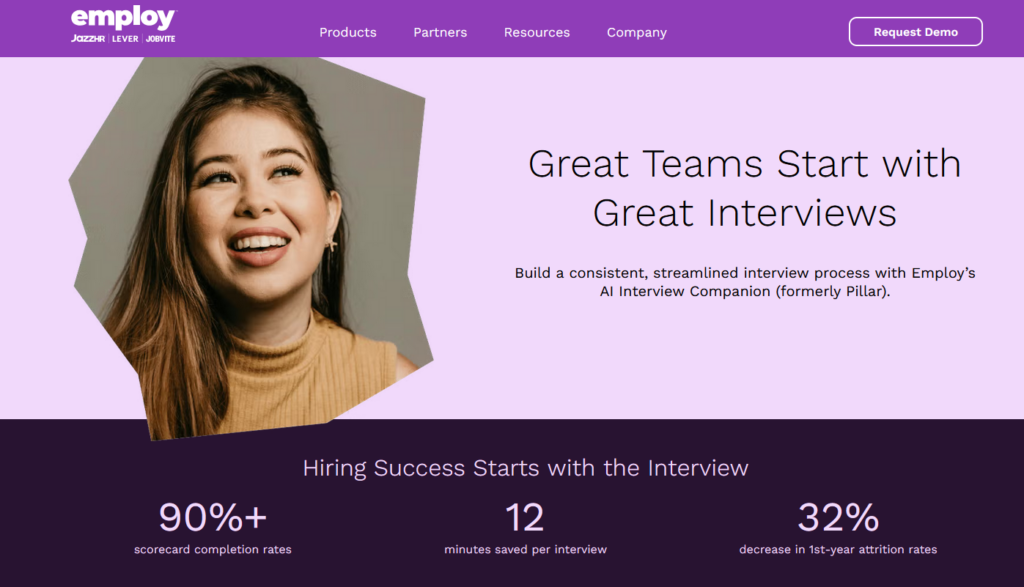
Best for: Teams using the Employ stack (JazzHR, Lever, Jobvite) that want in-interview guidance to reduce bias and inconsistency.
Pillar was acquired by Employ and is now positioned as Employ’s AI Interview Companion. The core focus is reducing the variance between interviews: prompts, structured frameworks, and post-interview analytics so hiring decisions rest on comparable evidence.
Pillar’s bet is that most interview problems come from inconsistency. Different interviewers asking different questions. Different bars applied to different candidates. The product tries to bring every conversation onto the same surface.
Key features:
- Real-time interview prompts and structured guidance
- Post-interview analytics on interviewer behaviour and candidate response patterns
- Tight integration with Employ’s ATS products
- Bias-reduction tooling
Stand-out strengths: Real-time guidance is genuinely useful. Natural fit inside the Employ ecosystem.
Limitations to consider: Strongest inside the Employ stack. Less compelling as a stand-alone purchase. Does not connect feedback to a dedicated learning library.
5. HireVue: Structured Video Interviewing at Fortune 100 Scale
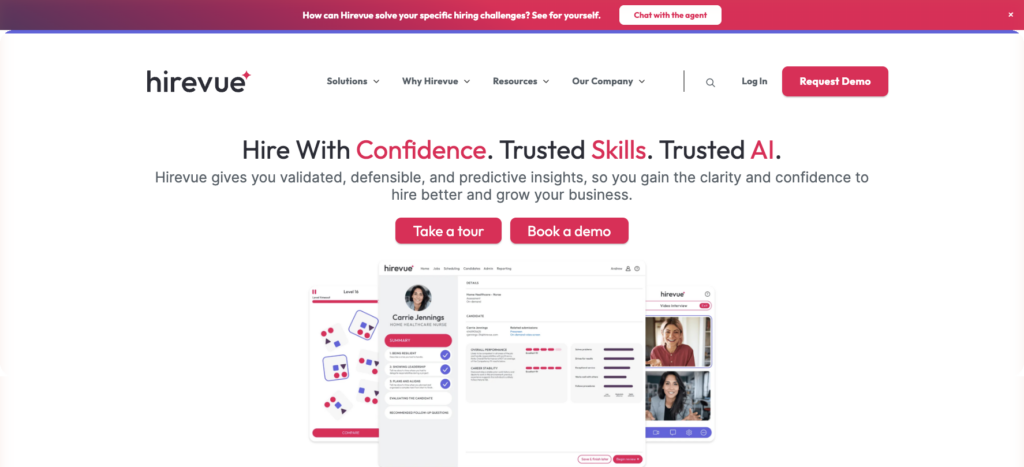
Best for: Global enterprises running high volumes of video interviews who want structured content, assessments, and AI-assisted evaluation in one stack.
HireVue has more than 700 major customers, including nearly half of the Fortune 100. The platform combines structured on-demand video interviews, live interviewing, game-based cognitive assessments, and interview insights powered by AI. Scheduling automation (“Builder”) connects to Google and Office 365 calendars and routes candidates to open slots without recruiter touch.
HireVue’s scale is its distinguishing feature. Few platforms have operated at the volumes HireVue has, and the assessment science library is deep.
Key features:
- On-demand video interviews with structured, science-backed content
- Game-based cognitive and numerical assessments
- AI-assisted interview insights and scoring
- Automated interview scheduling at scale
Stand-out strengths: Enterprise scale, mature assessment library, broad feature surface.
Limitations to consider: AI that scores candidates based on tone, word choice, or facial expressions carries a heavy compliance burden in 2026. Buyers in regulated markets should pressure-test this carefully against EU AI Act and US state-level requirements before adoption.
Considering HireVue? See our HireVue alternatives and SocialTalent vs HireVue comparisons.
6. Sapia.ai: Chat-Based, Structured First Interviews
Best for: Consumer, retail, and high-volume employers who want a structured, bias-conscious first interview that every candidate experiences identically.
Sapia.ai popularised the “first interview by chat.” Candidates complete an asynchronous, structured text interview on their phone or desktop, answering five open-ended behavioural questions. The AI analyses responses for competency signals, communication style, and values alignment, then ranks candidates and returns personalised feedback. Every candidate, every time.
The design choice that makes Sapia interesting is that the first interview becomes truly identical for every applicant. No accents, no camera comfort, no small talk, no interviewer mood. Structural consistency by construction.
Key features:
- Chat-based asynchronous structured interviews
- Behavioural, competency, and values analysis
- Personalised feedback for every candidate
- Bias-reduction design principles baked into the product
Stand-out strengths: Candidate experience is strong at volume. Ethical-AI positioning is more than marketing.
Limitations to consider: The product is a first-stage screener, not a full-loop interview intelligence platform. Pair it with something else for mid-funnel and final-round interviews.
7. Paradox (Olivia): Conversational Hiring at High Volume
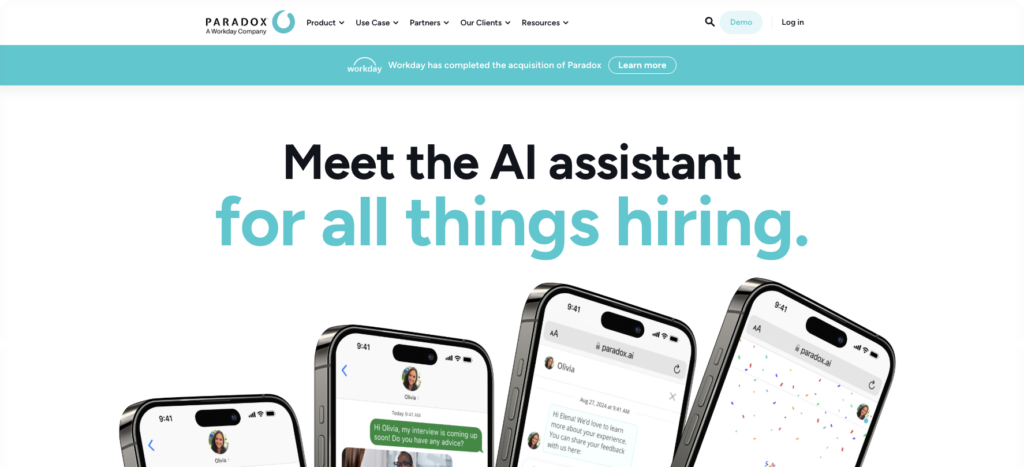
Best for: High-volume, frontline, hourly hiring at enterprise scale. Restaurants, retail, logistics, field service.
Paradox’s AI assistant Olivia runs the candidate flow for companies like McDonald’s, Chipotle, GM, and 7-Eleven. Screening, scheduling, status updates, and onboarding coordination happen through SMS and chat in 100+ languages, 24/7. Chipotle reported hiring 75% faster after deployment. GM reported $2M saved annually.
Paradox is less an interview intelligence tool than a candidate orchestration layer. The value is in eliminating the recruiter touch from high-volume transactional hiring.
Key features:
- Conversational screening via SMS and chat
- Automated interview scheduling with calendar sync
- Multi-language candidate support
- Deep integrations with enterprise HRIS and ATS
Stand-out strengths: Best-in-class for high-volume hourly hiring. Candidate completion rates are consistently high.
Limitations to consider: Less suited to professional, skilled, or technical roles where the interview itself matters more than the throughput. Pricing starts at enterprise levels with no self-serve tier.
8. Humanly: Conversational Screening for Mid-Market TA
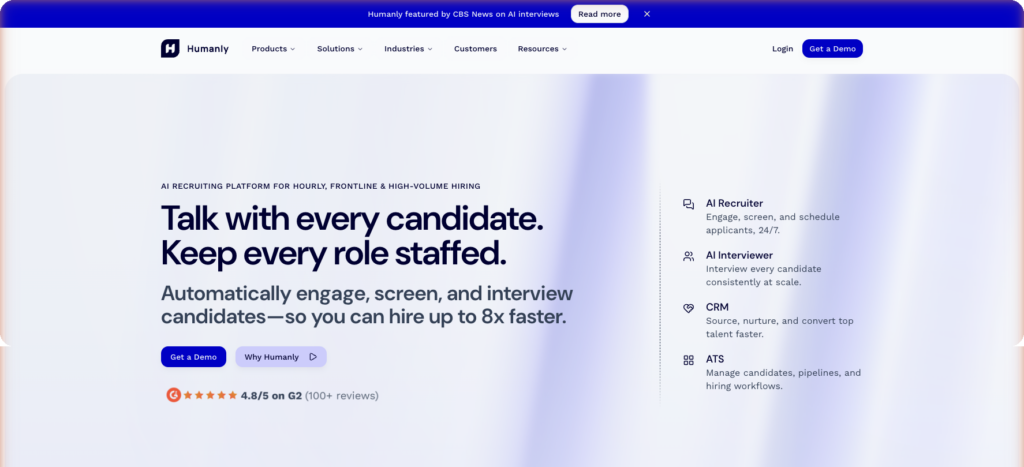
Best for: Mid-market TA teams that want conversational screening, scheduling, and interview intelligence in a single product.
Humanly combines a conversational AI for candidate engagement and screening, structured interview workflows, and a built-in talent CRM. The positioning leans toward distributed and high-volume hiring teams who want to reduce repetitive work without going full Paradox-scale.
Key features:
- Conversational AI for initial candidate engagement and screening
- Interview scheduling automation
- Post-interview notes and structured summaries
- Built-in CRM for candidate nurture
Stand-out strengths: Broad feature set for the price point. Faster deployment than enterprise-first alternatives.
Limitations to consider: Feature depth in any one area is shallower than dedicated point solutions. Enterprise TA teams evaluating compliance posture and admin controls should look closely before committing.
9. Phenom: Talent Experience Platform With Interview Automation
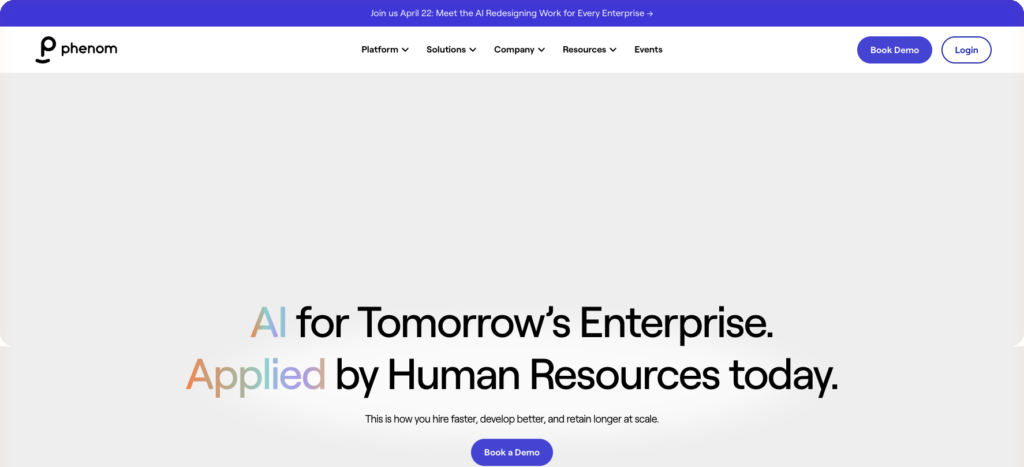
Best for: Large enterprises buying a broader talent experience platform where interview automation is one capability among many.
Phenom sells a talent experience platform. Career sites, candidate engagement, internal mobility, AI-powered search and match, and interview automation all live in one stack. The Phenom X+ assistant handles scheduling and engagement; interview workflows are embedded throughout.
For organisations consolidating TA tech onto a single vendor, Phenom is a serious contender. For organisations buying interview intelligence as a specialist capability, it’s a larger purchase than strictly necessary.
Key features:
- End-to-end talent experience platform
- AI-powered candidate engagement and personalisation
- Scheduling and interview coordination automation
- Internal mobility and talent marketplace
Stand-out strengths: Breadth. One vendor, one contract, one admin layer.
Limitations to consider: Interview intelligence is one module, not the core product. Depth of interviewer evaluation and coaching is lighter than category specialists.
10. Eightfold AI: AI Interviewer Inside Talent Intelligence
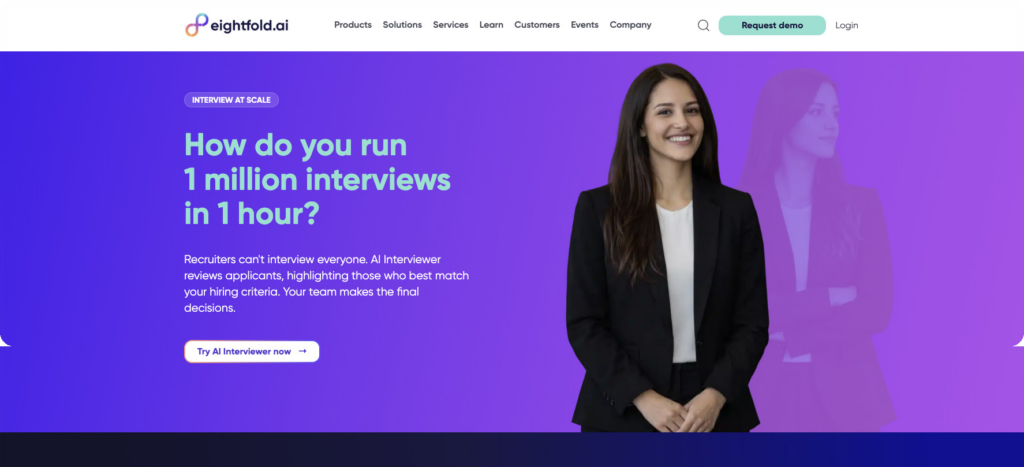
Best for: Enterprises investing in a broader talent intelligence platform (skills graph, internal mobility, workforce planning) that also want structured AI-assisted interviews.
Eightfold’s AI Interviewer sits inside its talent intelligence ecosystem. The product applies structured interview logic and AI-based evaluation to help teams assess candidates consistently. Where Eightfold differentiates is context. The platform already holds a deep skills graph, so interviews can be generated and evaluated against a skills-aware profile rather than a generic job description.
Key features:
- AI-generated, skills-aware interview content
- Structured candidate evaluation aligned to a skills graph
- Integration with Eightfold’s broader talent intelligence suite
- Enterprise governance and admin controls
Stand-out strengths: Skills context is genuinely useful. Strong for organisations already invested in the Eightfold ecosystem.
Limitations to consider: Best return on investment comes from buying Eightfold’s broader platform, not the AI Interviewer alone.
11. Harver: Pre-Employment Assessments and Culture Fit
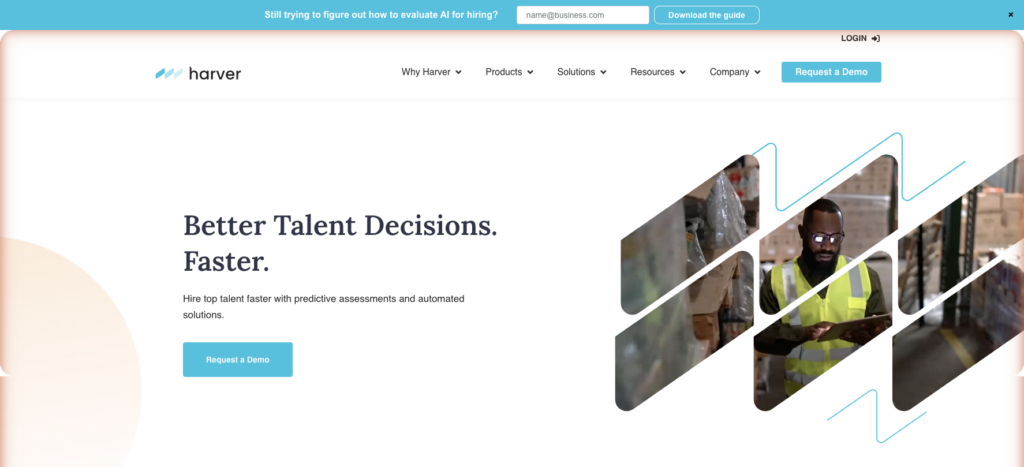
Best for: Organisations where early-stage assessment (skills, personality, values alignment) carries more weight than mid-funnel interview quality.
Harver combines skill tests, personality evaluations, and culture-fit analysis into a pre-employment assessment platform. The focus is on getting the shortlist right before hiring managers spend time in interviews.
Key features:
- Skills and cognitive assessments
- Personality and behavioural evaluations
- Culture and values alignment analysis
- Detailed analytics to support decisions
Stand-out strengths: Strong assessment library. Useful for filtering at the top of the funnel.
Limitations to consider: Pre-interview assessment is a different capability from interview intelligence. Treat Harver as complementary, not a substitute. Culture-fit algorithms also carry compliance complexity worth interrogating.
12. Hireflix: One-Way Async Video at Simple Pricing
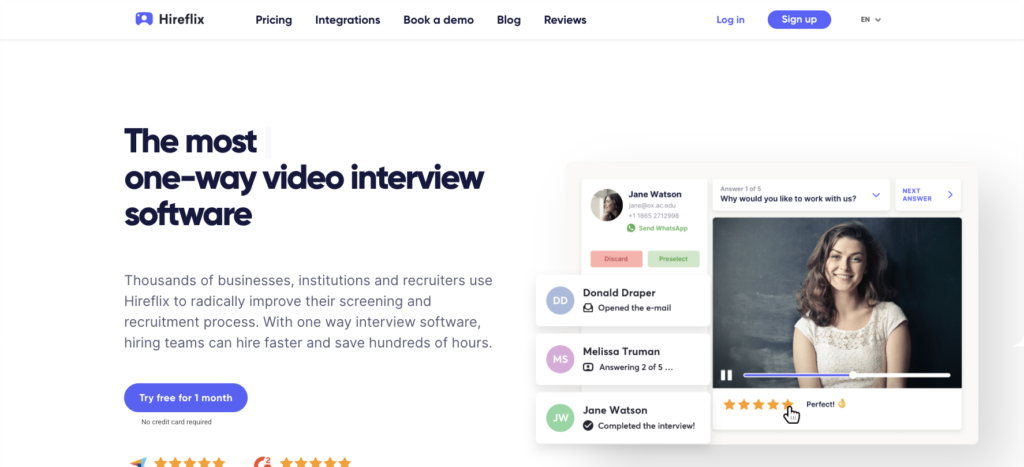
Best for: Growing companies that want one-way video interviews without enterprise pricing or enterprise complexity.
Hireflix is the simplest platform on this list. One-way async video interviews, flat pricing ($75/month Small, $150/month Medium), unlimited jobs, unlimited users, no per-response charges. It’s built for teams that need asynchronous video as a funnel stage without negotiating a six-figure enterprise contract.
Key features:
- Async one-way video interviews
- Flat, predictable pricing
- Unlimited jobs and responses within plan tier
- Simple setup and admin
Stand-out strengths: Clear pricing. No sales cycle required. Fast to deploy.
Limitations to consider: Single capability (one-way video). No interviewer coaching, no real-time guidance, no training linkage. It’s a tool, not a platform.
How to Choose Between Them
Narrowing 12 platforms down to the one you’ll actually buy is the hard part. Here’s the decision framework we’d use.
Start with a single question: what problem is bigger in your organisation right now: interview volume, interview quality, or interviewer capability?
If the answer is volume, meaning you’re hiring thousands of frontline workers, you need candidates through the funnel fast, and the interview itself is transactional, look at Paradox, Sapia, and Hireflix. Transactional hiring rewards automation and consistency, not deep interviewer coaching.
If the answer is quality, meaning you’re worried about inconsistent interviews, missing scorecard data, or interview notes that don’t stand up in a debrief, look at Metaview, BrightHire, and Pillar. These platforms clean up the documentation and surface the patterns.
If the answer is capability, meaning you know your interviewers aren’t trained well enough, you see the same mistakes repeat across requisitions, and every bad hire traces back to a conversation nobody prepared for, look at SocialTalent. Interviewer capability is the problem Cara was built to solve.
For most enterprise TA teams in 2026, the honest answer is all three, with capability being the one that’s been most chronically under-invested. Volume solves with automation. Quality solves with documentation. Capability only solves with training, guidance, and feedback in a connected loop. That’s the bar we’d hold every vendor on this list to as the category matures.
One last thing. If your legal team has started asking questions about how AI-generated interview summaries could be discovered in a discrimination claim (and they should be), evaluate every platform on this list through that lens. Tools that summarise whatever was said in the room, including biasing exchanges, are creating a discoverable record. Tools that deliberately omit biasing content and surface it as a coaching signal instead are solving a different problem. Know which category your vendor sits in before you sign.
Frequently Asked Questions
What is the difference between interview intelligence and AI interviewing?
Interview intelligence is software that supports human interviewers: planning, guiding, transcribing, coaching. The human runs the interview. AI interviewing replaces the human interviewer with a bot that asks questions and scores answers. The two categories overlap on this list but are structurally different. Enterprises in regulated markets generally buy interview intelligence; AI interviewing carries heavier compliance obligations.
What is the best interview intelligence platform for enterprise in 2026?
SocialTalent (Cara) is the most complete interview intelligence platform for enterprise talent acquisition teams (10,000+ employees, multiple geographies, regulated markets) because it covers the full before-during-after loop, connects interviewer feedback to targeted training, and evaluates interviewer behaviour rather than judging candidates. BrightHire is the closest category peer, with stronger legacy ATS integrations but no connected training library.
Does interview intelligence software evaluate candidates?
It depends on the platform. Some, including Cara from SocialTalent, deliberately do not evaluate candidates. They analyse interviewer behaviour (question quality, criteria coverage, bias signals, structure adherence) and feed that back to the interviewer privately. Others, including several AI interviewing and assessment platforms on this list, do score candidates against AI-generated rubrics. The distinction matters for compliance and for how the tool is experienced by hiring managers.
Is recording interviews with AI tools a legal risk?
It can be, depending on how the tool handles biasing content and what data is retained. Tools that summarise everything said in an interview, including responses to non-job-related questions, create a discoverable record of bias that an employer will later have to defend. Tools that omit biasing content and surface it as a coaching signal reduce that exposure. Candidate consent capture, data retention policies, and discoverability design should all be evaluated during procurement.
Which interview intelligence platform has the best ATS integrations?
For enterprise ATS coverage (Avature, Greenhouse, Workday, SAP SuccessFactors, Lever), SocialTalent, BrightHire, and Phenom are the strongest on this list. Metaview has clean integrations with most modern ATS platforms but is less enterprise-weighted. Check specific integration depth for your ATS before signing, since coverage varies by connector maturity.
Do interview intelligence platforms replace interview training?
Most don’t. They surface gaps but don’t close them. SocialTalent is the outlier because Cara connects each coaching insight to a specific micro-lesson from the SocialTalent learning library, so feedback and training are a single loop rather than two separate purchases. For organisations buying a recording or note-taking tool from this list, plan to pair it with a separate interview skills programme.
Can we just use ChatGPT to generate interview questions instead?
You can. Many teams already do. The problem is that results depend entirely on the prompt, and most hiring managers don’t know what good interviewing looks like. They don’t know what to ask ChatGPT for. Purpose-built platforms embed hiring methodology into the system so the output is defensible and consistent across every requisition, interviewer, and business unit. The difference shows up not in the first prompt but in the hundredth.
Why do companies struggle with consistent interview quality using software?
Because most interview intelligence tools document what happened in the interview without changing what happens next. The tool records the inconsistency in higher fidelity but doesn’t fix it. Common failure patterns include low hiring manager adoption (tools that add work rather than remove pain), training and technology living in separate budgets with no connected feedback loop, and tools that evaluate candidates rather than coaching interviewers. Consistency improves when the platform embeds methodology into the workflow, guides interviewers in the moment, and connects post-interview feedback to targeted training.
What are the leading interview intelligence platforms for reducing hiring bias?
For bias reduction specifically, the design of how the tool handles biasing content matters more than the feature list. SocialTalent (Cara) deliberately omits biasing content from interview summaries and surfaces it as a private coaching signal to the interviewer. BrightHire provides compliance-oriented analytics that flag interviewer behaviour patterns. Pillar (Employ) focuses on real-time guidance to reduce inconsistency and bias during the conversation. Sapia.ai uses identical chat-based first interviews to remove interviewer variability entirely at the screening stage. HireVue offers structured content and assessments but carries heavier compliance obligations around AI-based candidate scoring.
Which interview intelligence platforms improve recruiter and manager training?
SocialTalent is the only platform on this list that directly connects interview intelligence feedback to a dedicated interviewer training library. Cara identifies specific skill gaps after each interview and maps them to targeted micro-lessons, including certification paths (Licensed To Hire, Advanced, Licensed Interviewer). BrightHire surfaces coaching visibility to hiring leaders but does not include a training library. Most other platforms surface interview data without connecting it to structured learning, meaning organisations need to pair them with a separate training programme.
How do interview intelligence platforms improve hiring decisions over time?
By creating a cumulative feedback loop. In the first month, structured plans increase preparation and scorecard usage. By month three, consistency across interviewers becomes measurable. By month six, coaching feedback starts changing interviewer behaviour. By month twelve, quality-of-hire metrics reflect the compounded improvement. Platforms with a closed loop between feedback and training (like SocialTalent) accelerate this cycle because each insight triggers a specific intervention rather than sitting in a dashboard.
Which interview intelligence software helps standardize interviews across hiring managers?
For standardisation at enterprise scale, the platforms that generate structured interview plans with scoring rubrics are most effective. SocialTalent (Cara) generates role-specific interview plans from a job description in under five minutes, with criteria, questions, and rubrics distributed across interview rounds, then surfaces the plan inside the interview itself via Teams or Zoom. HireVue provides structured on-demand video content with science-backed questions. Pillar (Employ) offers real-time guidance to keep interviewers on a consistent framework. Metaview standardises note-taking and ATS output but does not structure the interview itself.
What causes hiring teams to misuse interview intelligence platforms?
The most common misuse patterns are: treating AI-generated interview summaries as objective truth without human review, using interviewer analytics as surveillance rather than coaching, buying recording technology without connecting it to interviewer training, evaluating candidate responses with AI scoring that creates discoverable bias records, and assuming hiring managers will adopt the tool without formal onboarding or workflow integration. Misuse typically stems from buying the technology before building the organisational capability to use it.
What interview intelligence platform works best with structured hiring processes?
SocialTalent (Cara) is the strongest fit for structured hiring processes because it generates the structure itself: role-specific interview plans, scoring rubrics, multi-round criteria distribution, and in-interview guidance, all grounded in a defined hiring methodology. BrightHire supports structured workflows through scorecard automation and recording aligned to predefined criteria. HireVue offers structured video content with science-backed assessment frameworks. For organisations that already have a structured process and need better documentation, Metaview is a strong fit. For organisations that need to build structure from scratch, Cara is the starting point.
Where This Category Goes From Here
The 2026 shortlist won’t be the 2027 shortlist. Three shifts are already visible in the category.
First, consolidation. AI scribes and recording tools will get absorbed into platforms with actual methodology underneath. Documenting an interview better does not improve the interview. The market is starting to understand that.
Second, the evaluation target is moving. Every platform on this list that claims to assess “interview quality” will eventually be asked the same question: are you evaluating the candidate or the interviewer? The answers will sort winners from losers fast, especially as regulatory pressure rises.
Third, training and execution are going to merge. Interview intelligence that tells you what went wrong but doesn’t help your interviewer get better before the next conversation is going to feel increasingly thin. Feedback needs to intervene, not just inform.
If you’re evaluating this category now, pick the platform that’s already built for where it’s heading, not the one that solved yesterday’s problem best. Those 45 minutes where a human is supposed to validate depth, probe for evidence, and make a defensible decision are not getting easier in 2027. Interview intelligence that makes every interviewer better is the capability that will still be worth the line item then, and in 2028, and the year after that.
Want to see what an AI hire built around the full interview loop actually does? See Cara in action.