
By David Deady
A bad hire costs up to 30% of that employee’s first-year salary in direct expenses alone, and the indirect damage to team morale, productivity, and customer relationships runs deeper still. This article breaks down every layer of that cost and shows what structured hiring practices can do to reduce it.
Highlights:
- SocialTalent helps enterprise hiring teams build more consistent, structured, and defensible hiring processes through recruiter and interviewer training.
- Direct costs can include recruitment advertising, HR and manager time, interviews, relocation, training, and replacement effort before the indirect impact is counted.
- Use the direct-cost formula in this article to calculate your own exposure: first-year attrition rate x $18,000 x number of hires.
- Structured interviews, thorough reference checks, and involving multiple evaluators are practical steps you can take to reduce hiring risk, all covered in the Mitigating the Risk section below.
- Beyond salary loss, bad hires carry hidden costs including damaged customer relationships, lost opportunity costs, and cultural disruption that rarely appear on a balance sheet.

The Stakes Behind Every Hiring Decision
When you bring a new team member on board, it’s more than just filling a seat – it’s a pivotal moment that can either drive your company forward or hold it back.
When you nail a hiring decision, it’s like catching lightning in a bottle! Productivity soars, innovation spikes, and your team’s energy levels seem to hit new heights. But make a misstep with a poor choice – the “bad hire” – and it can cost you dearly, far beyond just the salary paid. From the vibrancy of interactions to the core of company performance, a bad hire can disrupt it all.
Hiring mistakes are common enough that they deserve deliberate prevention, not just cleanup after the fact. Some of these are unavoidable – maybe the overall strategic direction unexpectedly changed, or a new hire gets poached – but there are ways to mitigate against this. Crucially it’s about investing the time and resources required to find the right people and also advocating the importance of this. Great recruiting is really the only panacea to a bad hire! Let’s get into it!
Defining a Bad Hire
What exactly makes a hire “bad”? It’s not just about lackluster performance. A bad hire can be someone who just doesn’t gel with the rest of the team or feels out of sync with the company’s ethos.
Or it might be someone who jumps ship too soon, leaving projects unfinished and teams in the lurch. Typically, these hiring missteps stem from a disconnect – a mismatch between what the job entails and the skills or personality of the employee.
If you want a clearer benchmark for whether a hire is working, quality of hire is the metric to track.
Common Causes of Hiring Mismatch
This disconnect could be the result of a few different things. Maybe the hiring process was rushed, skimping on thorough background checks or in-depth interviews.
Perhaps the job description was vague or overly ambitious, setting up expectations that no candidate could realistically meet. Or it could be that the company culture wasn’t clearly communicated, leading to a poor fit that frustrates both the employee and their colleagues.
Traits like adaptability, work ethic, and cultural alignment are often overlooked during rushed hiring processes, yet they are among the most telling indicators of long-term fit. Whatever the cause, the result is a hire that adds more friction than value to the organization.
Learn more: How to Interview for Culture Add
The Financial Impact
Before diving into the numbers, it’s important to understand that the financial impact of a bad hire extends beyond obvious expenses and can quickly compound across your organization.
Direct Costs
The immediate financial toll of a bad hire is startlingly clear. Recruitment costs start accumulating from the get-go with expenses related to recruitment advertising, cost-per-hire, the hours HR spends on the process, interviewing, and not to forget, any relocation and training investments for the newcomer.
Tracking recruiting KPIs can help you see where cost, attrition, and hiring quality are starting to drift. According to the U.S. Department of Labor, these missteps can cost up to 30% of the employee’s first-year earnings. For example, if the position pays $60,000 annually, that’s an $18,000 loss directly attributable to a poor hiring decision.
To calculate this further, you can use a simple equation:
First year attrition rate x $18,000 x Number of hires = Cost of bad hiring
If we plot in some numbers as an example, we can see the sum in action.
10% x $18,000 x 1,000 = $1.8million
And this doesn’t even provide a complete look at how financially impactful a bad hire can be. Besides the obvious salary loss, there are other factors which can also affect your bottom line.
Indirect Costs
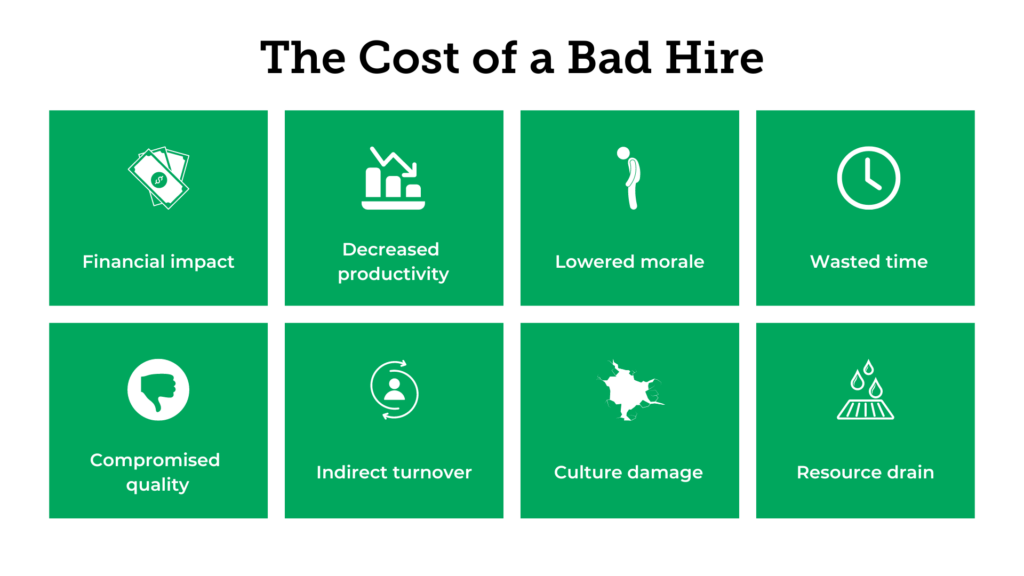
Beyond the obvious, the indirect costs of a bad hire are often more subtle yet far-reaching. Here’s how they break down:
- Decreased productivity: An underperforming hire doesn’t just fail to meet their own objectives – they can bog down the progress of the entire team, delaying projects and critical timelines.
- Compromised quality: Errors and subpar work don’t just affect internal metrics; they can tarnish the quality of your products or services, damaging your reputation and customer trust.
- Lowered morale: A mismatched employee can be a huge drain on team morale. Their frustration and disengagement can be contagious, sometimes pushing other valuable employees to the door.
- Management strain: Managers often find themselves overburdened with monitoring and correcting the shortcomings of a bad hire, pulling their attention from broader team development and organizational goals.
What Are the Hidden Costs of a Bad Hire?
Beyond the immediate and indirect expenses, bad hires carry hidden costs that, although less apparent, are profoundly impactful:
Cultural Disruption
An employee who doesn’t align with the company culture can cause more than just friction. They disrupt the harmony and flow of the workplace, making it hard for teams to collaborate effectively and maintain their usual productivity.
When a Rushed Hire Starts Costing More Than the Salary
You’re three weeks into a new hire’s onboarding and the warning signs are already stacking up:
- Their work needs constant correction, pulling two senior team members away from a product launch
- Your hiring manager admits the interview process felt rushed and the job description was vague
- You’re now looking at backfill costs, lost productivity, and a team whose morale is visibly dipping
This is the moment the real cost of a bad hire stops being abstract. It’s not just the salary. It’s the recruitment advertising spend, the hours your HR team won’t get back, the management time diverted from actual priorities, and the ripple effect on the people who stayed.
Damage to Customer Relationships
A bad hire in a client-facing role can damage customer relationships that took years to build, eroding trust and impacting your employer brand in ways that are difficult to recover from.
Opportunity Costs and Missed Growth
The resources devoted to managing a poor hire – time, energy, and money – represent a significant missed opportunity. Instead of dealing with performance issues, these resources could have been directed towards strategic initiatives or in support of high-performing employees who drive the organization towards its goals.
These hidden costs are challenging to quantify but critical to recognize, as they affect the underlying fabric and forward momentum of the company. There is a famous saying from American business person, Joe Kraus:
“The cost of hiring someone bad is so much greater than missing out on someone good.”
Essentially a cautionary tale against making hasty or poorly thought-out hiring decisions, this quote instead advocates for a careful, deliberate selection process to ensure the right fit for the role and the organization.
Mitigating the Risk
As John Vlastelica, Founder of Recruiting Toolbox and SocialTalent expert, says: “how we hire impacts who we hire.”
The best way to lower any instances of poor hires is to ensure your Talent Acquisition teams and Hiring Managers are all aligned, up-skilled, and optimized for success.
How to Reduce Bad Hires
With the right recruiter training and interviewer training embedded into your organization, you can quickly identify problem areas within the hiring process that may be allowing sub-par hires through the cracks.
Here are some examples:
1. Enhanced Screening Techniques
Organizations are bolstering their hiring processes with more rigorous candidate screening methods. This includes conducting thorough background checks to verify candidate credentials, deploying skills assessments to gauge technical abilities, and using behavioral interview techniques to explore a candidate’s personality and work style.
Reference checks, pre-employment screening, and competency-based interviews also play a key role in building a comprehensive view of an applicant, beyond what a resume and cover letter can show.
2. Improved Job Descriptions
Inclusive job descriptions are crucial. They set the stage by outlining precise role expectations and communicating the company’s core values. This clarity helps attract candidates who not only have the right skills but who are also more likely to thrive within the company’s culture.
3. Structured Interviews
Adopting a structured interview format helps maintain consistency and fairness in the hiring process. Using a set of standardized questions, employers can objectively evaluate the competencies and potential cultural fit of all candidates, ensuring that each one is assessed on an equal footing.
4. Involving Multiple Evaluators
Bringing multiple perspectives into the evaluation process helps reduce individual biases and leads to more balanced hiring decisions.
When candidates are assessed by diverse members of the organization, from different backgrounds and departments, the insights gained can paint a fuller picture of how well the candidate might integrate and contribute.
Where probationary periods are part of your hiring process, pairing them with clear evaluation criteria gives teams another checkpoint to confirm fit before making a longer-term commitment.
Turning Hiring Into a Strategic Advantage
Hiring is far from just filling a position; it’s a critical investment in your company’s future. Each new hire holds the potential to either propel your business forward or drag it down, making the stakes incredibly high.
The stark reality is that bad hires do more than just underperform—they can cause ripple effects that impact morale, productivity, and your bottom line.
But there’s good news: many of these hiring pitfalls are preventable. With deliberate, well-structured recruitment processes, and a keen focus on aligning candidates not just with the job role but also with the company culture, you can significantly reduce the risks.
Investing in comprehensive interviewer and recruiter training allows your organization to turn hiring into a strategic advantage, ensuring that every new team member is not just competent, but a catalyst for growth and innovation.
SocialTalent is the answer for solving the issue of bad hires. The SocialTalent platform gives recruiters and hiring managers the skills, tools, and insights needed to find, engage, and hire the best talent. Book an Intro with us.
Frequently Asked Questions
What is considered a “bad hire”?
A bad hire is an employee who underperforms, does not mesh with the team or company culture, or leaves the role too soon, leaving projects unfinished. It usually stems from a mismatch between what the job actually requires and the person’s skills or personality, often caused by a rushed process, a vague job description, or poorly communicated culture.
How much does a bad hire cost a company?
According to the U.S. Department of Labor, a bad hire can cost up to 30% of the employee’s first-year earnings, so a role paying $60,000 a year could mean an $18,000 loss. This direct cost covers recruitment advertising, HR hours, interviewing, and any relocation or training already invested in that person.
How common are bad hires?
Bad hires are widespread: research from Brandon Hall Group found that 95% of organizations admit to making a bad hire every year. Some are unavoidable, such as when company strategy shifts or a new hire is poached, but most can be reduced through more deliberate, better-resourced recruiting.
What are the indirect costs of a bad hire?
Beyond salary loss, a bad hire creates indirect costs including decreased team productivity, compromised quality of work, lowered morale, and added strain on managers who must monitor and correct performance issues. A Harvard Business Review study found that 80% of employee turnover can be traced back to poor hiring decisions.
How can companies reduce the risk of making a bad hire?
Companies can lower bad-hire risk through more rigorous screening such as background checks and skills assessments, clearer and more detailed job descriptions, structured interviews with standardized questions, and involving multiple evaluators from different backgrounds. Aligning and upskilling both talent acquisition teams and hiring managers is central to prevention.