
By David Deady
Bias in hiring is the set of instinctive preferences and assumptions that steer a recruiting decision away from the evidence. Most of it is unconscious. Nobody sets out to favor the candidate who went to their college, or to mark down the one who paused a beat too long before answering – and yet, interview after interview, that is what happens.
The cost is real: good people filtered out early, weaker hires waved through on a feeling, and teams that end up thinking very much alike. This guide covers 11 types of bias in recruitment, each with a hiring example and a practical way to reduce it. You don’t need to memorize them all – just recognize them when they show up in your own process.
What is bias in hiring?
Bias in hiring is any inclination for or against a candidate that is based on something other than their ability to do the job. Unconscious bias is the version that operates without our awareness – instinctive reactions, shaped by upbringing, culture and experience, that quietly tilt who gets screened in, interviewed and hired.
It comes from years of influences we had little say in – how we grew up, who we were surrounded by, what the media showed us. Most of it isn’t bad intent. It comes from a brain doing what brains do: taking shortcuts. That is also why good intentions alone don’t fix it. Harvard researchers Mahzarin Banaji, Max Bazerman and Dolly Chugh made this point in the Harvard Business Review in 2003: most of us believe we are unbiased decision-makers, and the research says most of us are wrong.
Check out SocialTalent’s full suite of Diversity, Equity, and Inclusion Training, expertly designed to help your organization promote diversity in the workplace and be more inclusive.
How unconscious bias shows up in hiring
Bias works through the ordinary machinery of a conversation – our perception of a candidate, our behavior toward them, what we pay attention to, how actively we listen, and the small nods we give some people more freely than others. Each shapes who we interview and who we hire. So the first step is simple to say and harder to do: make the unconscious conscious.
The types of bias in hiring at a glance
Jump to any of the 11 below for a definition, a hiring example and how to reduce it.
- Affinity bias – favoring candidates who share a connection with us.
- Similarity bias – preferring people who look, think and work the way we do.
- Confirmation bias – seeking evidence that backs up an early impression.
- Halo effect – one positive trait colors everything else.
- Horn effect – one negative trait colors everything else.
- Anchoring bias – over-weighting the first piece of information.
- Contrast effect – judging a candidate against the previous one, not the job.
- Conformity bias (groupthink) – going along with the panel.
- Beauty and appearance bias – equating looks with ability.
- Attribution bias – explaining others’ results by character, our own by circumstance.
- Nonverbal bias – over-reading body language.
Looking to build a more diverse pipeline of talent? Download our Building a Diverse Talent Pool e-book for practical tips and guidance.
1. Affinity bias
Affinity bias is the pull we feel toward people who remind us of ourselves – same college, same hometown, same sense of humor. SHRM defines it as the tendency to prefer or feel more comfortable with those who are similar to oneself. It’s warm and human, which is what makes it hard to spot.

In hiring: Picture an interviewer who discovers five minutes in that the candidate grew up two streets away. The questions get softer; a nervous answer earns a smile rather than a probe. In the debrief, that candidate “would fit right in”, while an equally capable stranger is “fine, but I’m not sure”.
How to reduce it: Write down scored criteria before anyone walks in and ask every candidate the same questions. If you notice the rapport kicking in, treat it as a cue to probe harder, not a reason to relax. Full definition: affinity bias.
2. Similarity bias
Similarity bias is affinity’s broader cousin: the general preference for people who look, think and work the way we do. We’re comfortable with it, so we hire for it, and over time the team becomes a hall of mirrors.

In hiring: A hiring manager keeps describing their ideal candidate as someone who “gets how we do things here”. Translated, that often means someone with the same background as the people already there – which is how “culture fit” becomes a polite name for homogeneity.
How to reduce it: Swap “culture fit” for “culture add” and ask what each candidate would bring that the team currently lacks.
Hiring for culture fit can be very problematic. Instead, look to hire for a culture add. Read more about it in our e-book.
3. Confirmation bias
Confirmation bias is our habit of looking for evidence that proves we were right. We form an impression early, then – without meaning to – hunt for the details that back it up and skate past the ones that don’t.
In hiring: A recruiter skims a résumé and thinks “job-hopper”. In the interview, every reasonable explanation for a short tenure sounds like an excuse. The candidate never really had an interview – they had a confirmation hearing.
How to reduce it: Delay the verdict on purpose. Score each answer against the criteria as you go, and when you notice a strong early impression, ask what evidence would change your mind – then go looking for it. Full definition: confirmation bias.
4. Halo effect
The halo effect is what happens when one impressive thing about a candidate casts a glow over everything else. A brand-name employer, a prestigious degree – and suddenly a vague answer sounds strategic.
In hiring: Two candidates give near-identical answers to a competency question. One worked at a company everyone admires. Their answer is written up as “strong commercial judgment”; the other’s is “a bit generic”. Same content, different halo.
How to reduce it: Compare every candidate against a clear ideal candidate profile and the objective criteria for the role, not the shine of a single credential.
5. Horn effect
The horn effect (sometimes “horns effect”) is the halo’s shadow. One negative detail – a typo, an awkward handshake – colors how we hear everything that follows.
In hiring: An interviewer decides early that a candidate who pauses before answering is “not quick enough”. From then on, thoughtful answers read as hesitant. The same behavior from a candidate they’d warmed to would be “considered”.
How to reduce it: Separate the trait from the job. Ask whether the thing that bothered you is actually a requirement of the role; if it isn’t, it doesn’t belong in the score.
6. Anchoring bias
Anchoring bias gives disproportionate weight to the first piece of information we receive. Whatever arrives first – a salary expectation, a headline credential – becomes the reference point for everything else.
In hiring: A hiring manager glances at a candidate’s current salary before reading their experience and concludes they must be “too junior” for the role.
How to reduce it: Review skills and experience before compensation details, and have each interviewer record their scores before the group discusses them.
7. Contrast effect
The contrast effect is judging a candidate against the one who came before rather than against the job. It’s an occupational hazard of back-to-back interviews.
In hiring: An average candidate interviewed straight after a weak one looks like a star. Straight after an exceptional one, they look like a safe pair of hands at best. Nothing about them has changed – only the comparison.
How to reduce it: Keep the only comparison that matters: the candidate’s skills against the role’s requirements. Score against written criteria straight after each interview.
8. Conformity bias (groupthink)
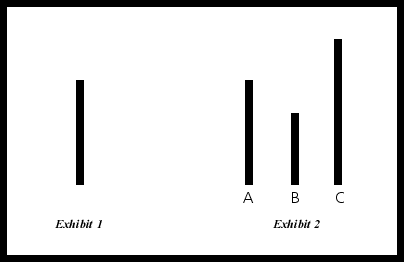
Conformity bias is the pressure to agree with the group. In Solomon Asch’s 1950s conformity experiments, participants matched a line to one of three comparison lines – an easy task, until the rest of the room, who were in on it, confidently gave the wrong answer. Roughly three-quarters of participants went along with an obviously wrong group answer at least once, and about a third of all answers conformed.
In hiring: Picture a debrief where the most senior person in the room opens with “I loved her”. Anyone with doubts now has to disagree with the boss in front of colleagues. Most won’t.
How to reduce it: Collect every interviewer’s scores independently before the debrief, and have the most junior person speak first. Disagreement is information – make it easy to voice.
9. Beauty and appearance bias
Appearance bias – often called beauty bias – is the assumption that people who look a certain way will perform a certain way. We associate attractiveness with competence and height with leadership, and rarely notice we’re doing it.
In hiring: There’s a reason the “looks like a CEO” idea persists. In Blink, Malcolm Gladwell reported that about 30% of Fortune 500 CEOs are 6’2″ or taller, compared with roughly 4% of American men.
How to reduce it: Take appearance out of the early stages – no photos on applications, phone screens before video – and score only what the role requires.
10. Attribution bias
Attribution bias is the lopsided way we explain success and failure. When we do well, it’s talent; when we do badly, it’s circumstances. When someone else does well, they were lucky; when they fail, it’s who they are.
In hiring: A candidate explains that a project they led missed its deadline because a key supplier collapsed. The interviewer hears “poor planning”. Another candidate describes a project that landed well, and the same interviewer thinks “right place, right time”.
How to reduce it: Ask follow-ups that separate the person from the situation: what did you control, and what would you do differently? Score the answer, not your theory about the cause.
11. Nonverbal bias
Nonverbal bias is placing too much weight on body language – eye contact, posture, a handshake. These cues feel like information about character. Often they’re information about culture or neurodivergence. One 2013 study found East Asian participants rated faces with direct gaze as angrier and less approachable, and CIPD’s neuroinclusion guide advises interviewers not to penalize a lack of eye contact.
In hiring: A candidate who avoids sustained eye contact is marked down for “lack of presence”. The interviewer has scored a habit, not a capability.
How to reduce it: Decide in advance whether a nonverbal behavior is genuinely job-relevant (it rarely is). Tell candidates what to expect from the format, so the assessment lands on their answers rather than their mannerisms.
Affinity bias vs confirmation bias
Affinity bias is about why you like a candidate – a shared connection. Confirmation bias is about what you do next – seeking evidence to justify a view you’ve already formed. They often arrive in sequence: affinity creates the warm first impression, and confirmation bias protects it.
Gender and age bias: the ones the law already names
Most of the biases above live in the gray areas. Gender and age bias don’t. In the US, Title VII forbids treating an applicant unfavorably because of their sex and the ADEA protects people aged 40 or older; in the UK, the Equality Act 2010 covers both. That doesn’t stop them operating unconsciously. In a randomized double-blind study of 127 science faculty, an identical application was rated significantly more competent and hireable as “John” than as “Jennifer”, with a mean starting salary of $30,238.10 against $26,507.94. A field experiment built on over 40,000 job applications found robust evidence of age discrimination in hiring against older women, especially those near retirement age.
How to reduce them: The same discipline as everything else here – blind screening, structured questions, role criteria – plus one habit: ask whether a concern (“energy”, “commitment”, “a few more years”) would be raised about a candidate of a different age or gender.
How to reduce bias in the hiring process
Awareness is the starting point, not the finish line. Knowing the names of 11 biases won’t stop them firing at the end of a long day. What helps is a process that makes the biased shortcut harder to take than the fair one.
- Structured interviews. Same questions, same order, for every candidate. It feels rigid at first. It’s also the biggest lever you have.
- Scorecards tied to the role. Define the criteria first and score each answer against them, not against other candidates.
- Independent scoring before the debrief. Capture every interviewer’s view in writing before anyone speaks.
- Diverse interview panels. Different people notice different things, and affinity bias is less likely to go unchallenged.
- Blind screening. Remove names, photos, dates and addresses before the first review.
- Inclusive job ads. Gender-neutral language, clear skills and no inflated requirement lists.
- Train the people who interview. A 2026 Robert Walters survey found three-quarters of UK hiring managers had never received formal interview training. Interview training for hiring managers makes fairer interviews repeatable, and unconscious bias and inclusive hiring training gives the whole team a shared vocabulary for calling it out.
From awareness to action
Here’s the honest bit: you won’t eliminate bias. You’re human, and so is everyone on your panel. But you can stop it being the deciding factor. Pick the two or three biases on this list you recognized a little uncomfortably, find where in your process they get their chance, and close that gap with structure. The more you check yourself, the more progress you’ll make – and the better the people you’ll hire.
SocialTalent’s DEI training can help you deliver more inclusive and successful interviews, whether you’re a recruiter or a hiring manager.
Frequently Asked Questions
What are the main types of bias in hiring?
The most common types of bias in hiring are affinity bias, similarity bias, confirmation bias, the halo and horn effects, anchoring bias, the contrast effect, conformity bias, beauty or appearance bias, attribution bias and nonverbal bias. Each nudges a decision away from job-related evidence, and each can be reduced with structured interviews and criteria-based scoring.
What is unconscious bias in recruiting?
Unconscious bias in recruiting refers to instinctive, unintentional judgments that shape how recruiters and hiring managers perceive and evaluate candidates without deliberate intent. They form over a lifetime through upbringing, socialization and media influence, and affect how candidates are perceived, listened to and scored.
What is affinity bias?
Affinity bias is the tendency to prefer or feel more comfortable with people who are similar to us, such as those who share our university, hometown or interests. In hiring it leads interviewers to rate those candidates more generously than equally capable candidates they feel no connection with.
What is the difference between affinity bias and confirmation bias?
Affinity bias is about why you warm to a candidate: a shared background or connection. Confirmation bias is about what you do next: seeking out evidence that supports the impression you have already formed and discounting evidence that contradicts it. They often work together: affinity creates the first impression and confirmation bias protects it.
What is the difference between the halo effect and the horn effect?
The halo effect happens when one positive trait, like a prestigious degree or a brand-name employer, makes an interviewer view everything else about a candidate favorably. The horn effect is the opposite: one negative detail, such as a slow speaking style, taints perception of a candidate’s other qualities. Scoring each criterion on its own evidence helps counter both.
How do you reduce unconscious bias in hiring?
Run structured interviews with the same questions for every candidate, score answers against criteria defined before the interview, have interviewers record scores independently before the debrief, use diverse panels, blind-screen applications, write inclusive job ads and train hiring managers to interview consistently.