
By Johnny Campbell
AI is changing hiring in three stages: deploying small efficiency gains, reshaping workflows, and inventing new models. This article uses the Deploy, Reshape, Invent framework to examine where AI can improve speed and consistency, where human judgment still matters, and what responsible adoption could look like next.
Highlights:
- McDonald’s use of Olivia in its McHire workflow cut application time from 10 minutes to two and average time-to-hire from about 14 days to two, according to Franchise Times.
- AI’s impact differs across hiring contexts: high-volume roles can benefit more from automation, while specialized hiring relies more heavily on human interaction and judgment.
- Agentic AI could coordinate more of the hiring workflow, but consequential decisions still need human oversight and accountability.
- Structured evaluation, fairness controls, and consistent interviewer practices remain important as AI use grows.
- Use the Deploy, Reshape, Invent framework to identify where your organization is today and where AI can support the next stage.
Back in the 90s, I worked at a video store. You remember those, right? Rows and rows of VHS tapes, a handful of copies of The Shawshank Redemption, and a lot of customers who waited (sometimes for hours!) just to get their hands on the latest release. In my early teens I was essentially IMDB for my local corner of Dublin, recommending comedies and thrillers to customers who had no idea what to pick!
Then Netflix arrived.
First, it reshaped the industry with DVDs mailed directly to your home. No waiting in line, no late fees. And then came streaming – a complete invention that obliterated the old model.
The video store? Gone.
We’re now at a similar inflection point in hiring. AI isn’t just tweaking how we work, it’s completely transforming it. It’s the internet moment for recruitment, and it’s moving fast. So, how do we frame this change? The Boston Consulting Group’s framework of “ Deploy, Reshape, Invent”, which I mentioned in my hiring trends article, provides a helpful lens. Let’s break it down.
Deploy: Incremental Gains with AI
AI has already started to change the game by helping us deploy small but meaningful improvements. Think of tools like ChatGPT drafting job descriptions, writing Boolean strings, or automating interview scheduling.
Automated Scheduling and Admin
Many companies are using AI to auto-schedule interviews, reducing their time-to-schedule to mere minutes.
Candidate Sourcing
AI is also accelerating candidate sourcing. Recruiters can use AI for recruitment and sourcing to search proactively and surface passive candidates who might otherwise be overlooked. This isn’t revolution, though – it’s evolution. Small changes that save time, eliminate admin work, and create efficiencies.
It’s like those early days of the internet when businesses built websites to showcase opening hours or allowed customers to check stock online. Useful? Sure. Groundbreaking? Not yet.
Reshape: Redefining Processes
This is where things start to get really exciting. AI isn’t just automating individual tasks, it’s starting to reshape how we approach hiring entirely.
One of the best examples I’ve found of this revolves around McDonald’s. They operate on a staggering scale: 40,000 locations across 120 countries, making 2 million hires per year. For organizations operating at this scale, AI in high-volume hiring can reduce manual bottlenecks while keeping the candidate journey moving. For them, hiring efficiency isn’t just a nice-to-have, it’s a business imperative.
The McDonald’s McHire Case Study
Here’s the challenge they faced: McDonald’s wanted to speed up restaurant hiring while improving the candidate experience and giving managers more time to focus on operations.
Automated Screening, Scheduling, and Offers
Enter McHire, an AI-driven hiring system powered by Paradox. Instead of job applications requiring CVs and lengthy forms, candidates simply text a number. The AI-powered chatbot handles the rest – automated resume screening, interview scheduling, and sending offer letters.
Franchise Times reported that the application process dropped from 10 minutes to two, while average time-to-hire fell from about 14 days to two.
This is reshaping in action – AI not just supporting hiring but fundamentally redefining it.
Invent: What’s Next for Hiring?
So, if we’re deploying AI and reshaping processes, what does the “invent” stage look like?
Think of Netflix. After reshaping the video rental industry by mailing DVDs, they invented an entirely new model: streaming. Similarly, the invention stage in hiring will take us beyond automation and into entirely new paradigms.
Agentic AI and Coordinated Workflows
This is the era of agentic AI – systems designed to coordinate multiple hiring tasks across a workflow while keeping people responsible for consequential decisions.
As these systems take on more responsibility, teams need clear guardrails for ethical AI in hiring, including human oversight for consequential decisions.
Building the capability to use these tools well requires more than access to technology; AI Academy training can help hiring teams build practical, responsible AI skills.
Skills-Based and Simulation-Led Assessment
Imagine hiring without CVs. Instead of screening documents, AI could assess candidates’ skills, experiences, and potential in real time. What if interviews became simulations tailored to the role? Or assessments were gamified to reveal strengths and weaknesses?
The seeds of this are already being sown. We’re not there yet, but the shift is coming.
The Hiring Spectrum: McDonald’s vs. Michelin Star
But not all jobs are created equal. And AI’s impact will differ depending on the scenario. That’s why it’s helpful to think of hiring on a spectrum – from low-skill, high-volume roles to highly differentiated, specialized positions.
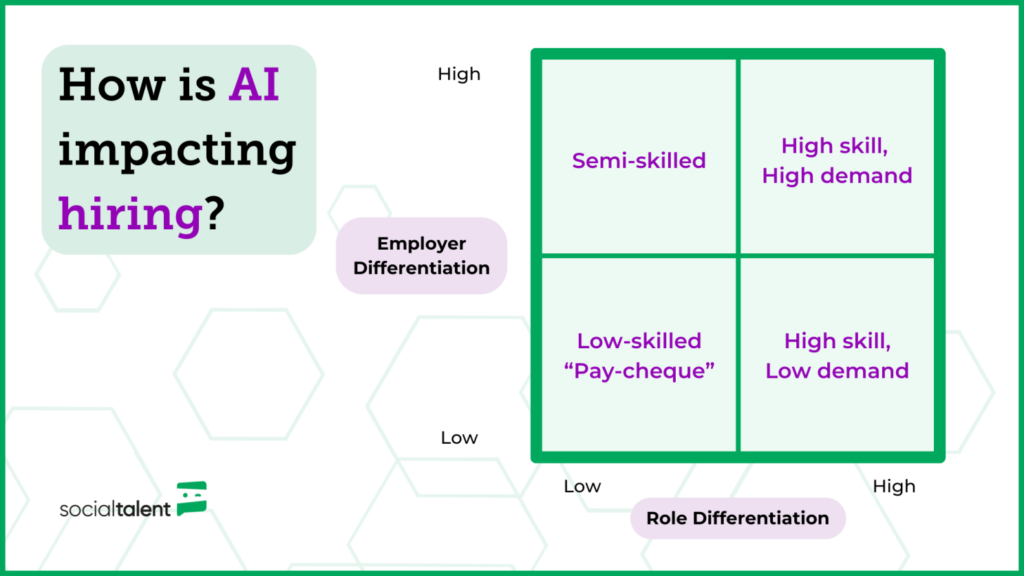
High-Volume Roles: Speed and Consistency
At the “fast-food” end, speed and consistency are most often king. Automation drives efficiency, reducing friction and ensuring that every step, from application to onboarding, is seamless. Candidates want quick answers and clear processes – they don’t need a recruiter holding their hand.
Specialist Roles: Automation Meets Human Judgment
Now, shift to the other end of the spectrum. Here, personalization in the hiring process is the priority. Candidates for high-skill roles expect a tailored experience, human interaction, and white-glove treatment. They want to feel valued and courted.
At this end of the spectrum, a personalized candidate experience helps candidates feel valued without sacrificing process consistency.
That doesn’t mean automation has no place at this level. Think of the Michelin-starred restaurant as an allegory, where you book your table online and pay the bill with a QR code. These automated touches enhance the elevated experience, freeing up the staff to focus on creating unforgettable moments for diners.
The same principle applies to hiring. AI can handle interview scheduling or provide insights to hiring managers, but the core of the process – the connection, the engagement – remains a matter of human judgment.
AI in Hiring: Risks, Fairness, and Human Oversight
Human judgment remains essential as AI adoption grows across recruitment. AI should complement human expertise, not replace it.
The spectrum above makes this clear. At every point, from fast-food volume hiring to Michelin-starred specialist search, data and automation only go so far. Structured frameworks, consistent evaluation standards, and trained human interviewers can support fairer, more defensible decisions while keeping people accountable for hiring judgment.
What AI in Hiring Means for the Organizations That Adapt
AI is already transforming hiring, from the McDonald’s of the world to the Michelin-starred experiences. Whether it’s automating scheduling or inventing entirely new ways to evaluate talent, the possibilities are endless.
But here’s the thing: The organizations that will thrive are the ones that embrace this change. Those that cling to old processes risk becoming the video stores of hiring – left behind by a world that’s moving on.
Teams ready to put these ideas into practice can see how SocialTalent hiring training helps build more consistent hiring capability.
The choice is yours. Are you ready to deploy, reshape, and invent? Let me know your thoughts, and as always, thank you for reading.