Rudge argues that integrating new hires requires deliberate socialization on both sides, not just a smooth onboarding deck. When she introduced new chicks to her existing flock without proper transition, the bigger chickens turned aggressive, mirroring what happens when TA teams fail to prepare both incoming talent and incumbent teams for change.
The Hiring Excellence Podcast · Episode 236
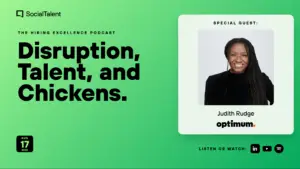
Disruption, Talent, and Chickens: Judith Rudge's TA Lessons
Optimum's Judith Rudge swaps AI buzzwords for barnyard wisdom—chickens teach surprising lessons on onboarding, leadership rotation, and disruptive hiring.
 Johnny CampbellHost · Co-founder & CEO, SocialTalent
What you'll learn
Recognize why disruptive, non-conforming hires can strengthen your organization's innovation
Use field immersion to generate fresh AI use cases from your own recruiters
Encourage high performers to take time off so others can step up
Challenge your team to generate their own AI experiments instead of dictating them
00:00
--:--
Episode notes
Episode key takeaways
Rotating leadership responsibility, rather than always defaulting to your top performer, can unlock latent capability elsewhere on the team. When Rudge removed her most dominant hen from the flock, a new leader emerged within days, which she now applies to talent management by intentionally moving people out of default lead roles.
The most disruptive personality on a team isn't necessarily a liability - it can be the early-warning system the group needs. Her most unruly chicken, Carmen San Diego, is also the loudest to signal danger, which reframed how she now advocates for hiring leaders from outside the industry who won't conform to existing culture.
Connecting the TA candidate journey to the customer experience can create unexpected value in consumer-facing businesses. Rudge's team built a handoff between their recruiting AI chatbot and the customer service bot so applicants who are also customers get routed appropriately, turning a routine interaction into what she calls a delight moment.
Telecom's disruption predates most people's timelines, and TA has to move at the pace of the business or fall behind it. Rudge recalls a Verizon all-hands fifteen years ago where leadership dismissed Netflix as a threat, a moment she now uses to explain why talent teams must anticipate change rather than react to it.
Good to know
Frequently asked questions
The quick answers behind this episode.
What can talent acquisition leaders learn from raising chickens? +
Judith Rudge, VP of TA at Optimum, found that watching her flock of chickens revealed real lessons about onboarding, leadership rotation, and disruption. Introducing new chickens taught her about integration; removing a dominant hen showed how rotating leaders unlocks new talent; and her most disruptive chicken demonstrated the value of non-conforming hires.
How should companies integrate new hires into an existing team culture? +
Rudge learned from mixing chicken flocks that dropping new talent in without preparation causes friction on both sides. She rebuilt her team’s candidate storytelling to address ‘what’s the pace like here’ and ‘what’s your persona needing to be like to be happy here,’ rather than relying on generic onboarding messaging.
Why is it risky to always assign top performers the biggest projects? +
Rudge observed that when she removed her most dominant, aggressive chicken from the flock, a different chicken rose to lead within days. She applies this to talent management, arguing leaders should rotate high-visibility opportunities rather than always defaulting to the same top performer, which can stagnate the rest of the team.
How is telecom disruption connected to talent acquisition strategy? +
Rudge points to a Verizon all-hands fifteen years ago where leadership dismissed Netflix as a non-threat to telecom, a call that proved wrong. She argues TA teams sit at the forefront of business change and must move faster than the industry itself, since ‘if the change is happening in the industry and the business at pace, your TA team needs to be changing faster.’
How can recruiting chatbots improve the customer experience in consumer businesses? +
At Optimum, Rudge’s team connected their recruiting AI chatbot to the customer service bot, since many job applicants are also existing customers. This creates a natural handoff so candidates get routed to the right support, turning what could be a missed touchpoint into an integrated brand experience.