The skills gap is forcing a fundamental shift in how organizations think about hiring. Instead of waiting for ready-made talent, leading companies are investing in academies, MOOCs, and structured training programs to develop candidates from foundational levels—then measuring success not just by speed-to-hire but by retention and diversity outcomes.
The Hiring Excellence Podcast · Episode 84
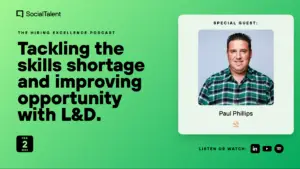
Tackling the skills shortage and improving opportunity with L&D | with Paul Phillips
Nine in ten organizations face a skills crisis. Paul Phillips shares how Avanade invests in internal academies, pre-hire learning programs, and inclusive leadership training to build talent pipelines rather than compete on compensation alone.
 Johnny CampbellHost · Co-founder & CEO, SocialTalent
What you'll learn
Break large hiring pushes into dedicated tiger-team style talent squads
Build grow-your-own academies to fill skills gaps the market lacks
Certify interviewers through license-to-hire training to reduce bias and improve experience
Turn employees into recruiters through a talent ambassador advocacy program
00:00
--:--
Episode notes
Episode key takeaways
Avanade's Brazil program illustrates the power of this approach: two hundred female candidates with no tech background were trained across multiple disciplines, and female hiring jumped from 18% to 30% in that market. The program also surfaced overqualified candidates who fed into core pipelines, creating a multiplier effect.
Learning and development is no longer a post-hire function. Pre-hire education—offering MOOCs and learning opportunities before someone joins—serves as both a talent magnet and a corporate social responsibility lever, especially for younger cohorts who rank L&D in their top three reasons to join an organization.
Internal mobility at scale requires deliberate design. Removing barriers (allowing applications two grades above current level, not just one) and pairing it with inclusive leadership training creates stickiness; Avanade saw turnover drop 5–6 points in volatile markets by coupling growth opportunities with psychological safety and belonging.
Scaling hiring without sacrificing quality demands a 'license to hire' mindset. Over five thousand Avanade employees completed interview training in six months, expanding the interviewer pool from five hundred to nineteen hundred while reducing unconscious bias and improving candidate experience—freeing capacity and distributing hiring as a shared business responsibility.
Good to know
Frequently asked questions
The quick answers behind this episode.
How do you adjust hiring processes when the market doesn't have the skills you need? +
Create dedicated teams focused on sourcing and hiring at scale. Avanade’s ‘Talent at Scale’ approach pulled interviewers from day jobs, leveraged business ambassadors, and scheduled dedicated interviewing days. For security roles, they hired over five hundred professionals and launched a cyber academy across thirteen countries—proving that speed and volume are possible when you treat hiring as a business priority, not a transactional process.
What's the ROI of investing in pre-hire learning programs? +
Pre-hire learning serves dual purposes: it attracts candidates (especially younger talent who rank L&D in their top three job criteria) and it widens the talent pool by removing barriers to entry. Avanade used influencers and social media to promote learning opportunities in Brazil, generating overwhelming response and feeding both new hires and internal pipelines with overqualified candidates who initially underestimated their own skills.
How do you get business leaders to accept candidates without all required skills? +
Reframe the conversation around retention and growth, not just hiring speed. McKinsey research shows organizations are bridging skills gaps 3-to-1 through development versus hiring. When leaders see turnover dropping and diversity improving—as Avanade did in Brazil—they become advocates. Board-level buy-in and clear workforce planning (mapping skill needs, market availability, and time-to-readiness) make the case irrefutable.
What core skills matter more than technical skills now? +
Inclusive leadership, psychological safety, and courageous conversation skills are rising fastest. As organizations become more consultative and advisory-led, they need leaders who can build empathy, navigate privilege, and create belonging. Avanade prioritizes these ‘human impact skills’ (not ‘soft skills’) through training and peer mentoring, recognizing that technical skills change fast but leadership culture compounds over time.
How do you communicate L&D investments to attract talent at scale? +
Employee advocacy and short-form video outperform polished employer branding. Avanade captures sixty-second employee stories on video, generating 2–3x more clicks on LinkedIn than traditional content. Combined with third-party validation (top employer awards, Newsweek rankings), this approach scales authenticity without requiring constant marketing effort—letting employees tell their own story.