Synopsys built a clear, measurable business case for AI in intake by quantifying meeting volume and time saved on note-taking. Across an estimated six thousand-plus intake meetings a year, even a conservative thirty-minute saving per recruiter adds up to a huge productivity gain.
The Hiring Excellence Podcast · Episode 238
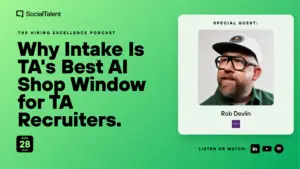
Why Intake Is TA's Best AI Shop Window for TA Recruiters
Rob Devlin explains why AI-powered intake meetings deliver measurable ROI - and why they're TA's safest, highest-impact place to start with AI.
 Johnny CampbellHost · Co-founder & CEO, SocialTalent
What you'll learn
Identify a vendor's true core proposition instead of feature lists
Shrink downstream hiring volume by tightening role scope earlier
Classify AI use cases by candidate-facing versus internal-facing risk
Involve legal and governance partners from a project's very start
00:00
--:--
Episode notes
Episode key takeaways
The real prize isn't the hours saved on admin - it's what recruiters do with that reclaimed time. Freeing up forty-five minutes per intake lets recruiters focus on relationship-building, coaching, and influencing conversations that AI simply can't replicate.
Rather than chasing the flashiest AI use cases, Synopsys mapped a risk axis from low-complexity tasks like intake summarization up to high-stakes decisions like candidate screening. The guiding principle is that the closer AI gets to influencing a decision about a person, the more oversight it demands.
Scaling multiple AI projects in parallel required a simple internal framework built around three A's: alignment on the problem being solved, alliance across internal teams and vendors, and adoption by the recruiters who'll actually use the tools day to day.
Good to know
Frequently asked questions
The quick answers behind this episode.
Why should TA teams start their AI rollout with intake instead of sourcing or screening? +
Intake is high-value but comparatively low-risk because it deals with internal-facing data rather than candidate-facing decisions. It’s also the most important part of recruitment, where a recruiter acts as adviser and stenographer at once – making it an ideal, low-risk ‘shop window’ to prove AI’s value before tackling riskier, candidate-facing use cases.
How much time can AI save recruiters during intake meetings? +
Synopsys estimated over six thousand intake meetings per year and conservatively calculated a thirty-minute saving per recruiter on typing and interpreting notes – translating to roughly three thousand hours saved annually. That time was reinvested into higher-value human work like coaching hiring managers and supporting candidates, rather than treated purely as a productivity win.
What legal risks should TA leaders consider before deploying AI in hiring? +
Global hiring means navigating different legislation, privacy, data protection, security, and bias rules across regions, including emerging laws beyond well-known frameworks like the EU AI Act. One example raised is a separate publishing-disclosure law requiring AI-generated content, such as job descriptions, to be declared – a requirement many recruiters aren’t yet tracking.
How do you get legal and compliance teams on board with AI in TA? +
Build the relationship early rather than treating governance as a final approval step. The advice is to become best friends with legal, privacy, security, and governance teams from the start, involve them throughout the journey, and use early wins on low-risk use cases to build trust before tackling higher-risk AI applications.
What framework helps manage multiple AI projects in TA at the same time? +
A simple three-part framework – alignment, alliance, and adoption – helps keep parallel AI projects on track. Alignment ensures everyone agrees on the problem being solved, alliance brings together the internal and vendor teams needed to build the solution, and adoption ensures recruiters actually use the technology once it’s live.